
Messier 31 / NGC 224
2015
Inspect Observation
Hubble Space Telescope
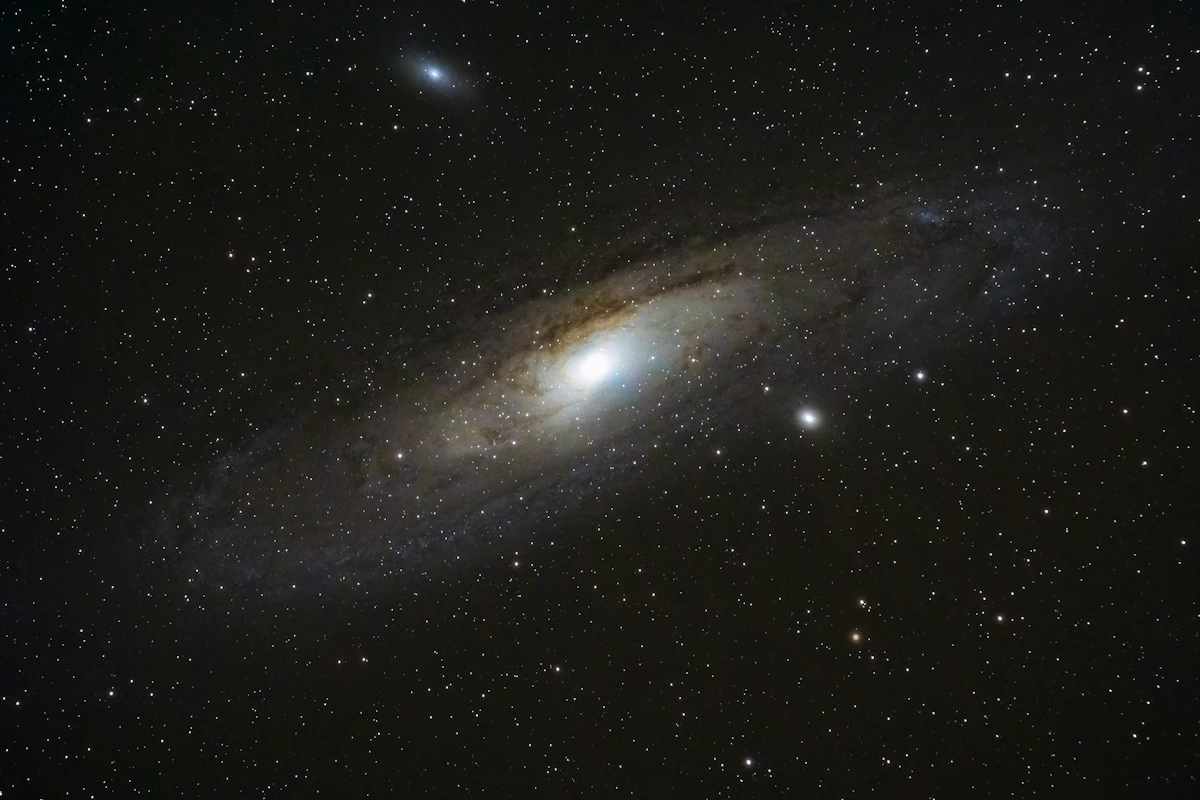
Andromeda Galaxy (M31)
Our nearest major spiral galactic neighbor, containing over one trillion stars and spanning 220,000 light-years across.
Credit: NASA/ESA
Explore the majesty of the cosmos through premier astronomical observations, captured by space telescopes and scientific missions, paired with an interactive encyclopedia of foundational cosmic phenomena.
118 Cosmic Elements
Big Bang to Heavy Mergers
12 Deep Space Observations
NASA / ESA / JWST
12 Scientific Terms
Astrophysics Encyclopedia
Hubble • JWST • Chandra • Cassini
Multi-Wavelength Missions
Loading today's cosmic image...
Explore all 118 elements of the universe, discovering their atomic properties and celestial birthplace—from the Big Bang to colliding neutron stars.
Peer across billions of light-years through deep space observations captured by NASA, ESA, and international astronomical observatories.
Our nearest major spiral galactic neighbor, containing over one trillion stars and spanning 220,000 light-years across.

A narrow window into primordial cosmic history containing nearly 10,000 galaxies stretching back 13 billion years.

Spectacular infrared panorama of a hyperactive stellar nursery where nascent stars emerge from towering gas and dust peaks.

Towering columns of interstellar gas and cold molecular hydrogen sculpting newborn proto-stars in M16.

The closest massive star-forming factory to Earth, glowing vividly with ionizing radiation from young Trapezium stars.
Composite view of our galaxy's dense stellar center, harboring supermassive black hole Sagittarius A*.

The fragile, luminous veil of Earth's atmosphere silhouetted against the dark vacuum of outer space.

Ancient river delta lakebed on Mars, investigated for fossil biosignatures and sedimentary history.

The expanding wreckage of a cataclysmic stellar explosion recorded by global astronomers in 1054 AD.

Brilliant white stellar bulge encircled by a dramatic symmetrical dust lane resembling a wide-brimmed sombrero.

Gravitationally warped light arcs and distant background galaxies revealing the geometric curvature of spacetime.

Intricate orbital rings of water ice and micro-meteoroids orbiting the solar system's jewel planet.
Demystifying key scientific terms, celestial phenomena, and mathematical formulas governing the cosmos.
[ blak hohl ]
A region in space where gravity is so strong that nothing, not even light, can escape from it.
Predicted by Albert Einstein's General Relativity (1915). Formed when supermassive stars undergo gravitational collapse at the end of their thermonuclear lifecycles.
[ lahyt-yeer ]
The distance that light travels through space in one Earth year, approximately 9.46 trillion kilometers.
[ soo-per-noh-vuh ]
A colossal, luminous explosion that marks the violent end of a massive star's life.
[ ek-soh-plan-it ]
A planet that orbits a star outside our solar system in another distant star system.
[ neb-yuh-luh ]
A gigantic interstellar cloud of gas and dust where new stars and planetary systems are born.
[ gal-uhk-see ]
A massive gravitational system consisting of billions of stars, planets, gas, and dark matter bound together.
[ as-tuh-roid ]
A rocky, airless remnant left over from the early formation of our solar system, usually orbiting the Sun between Mars and Jupiter.
[ kom-it ]
A cosmic snowball of frozen gases, rock, and dust that warms up when near the Sun, displaying a glowing coma and spectacular tail.
[ ih-vent huh-rahy-zuhn ]
The one-way causal boundary surrounding a black hole where the spacetime escape velocity strictly equals the speed of light in vacuum, preventing any causal signal or matter from escaping outward.
[ dahrk mat-er & en-er-jee ]
The unseen, mysterious components that constitute approximately 95% of the total cosmic mass-energy budget. Dark matter binds galaxies gravitationally, while dark energy drives the accelerating cosmic expansion.
[ puhl-sahr / noo-tron stahr ]
A hyper-dense, highly magnetized rotating neutron star that sweeps collimated beams of electromagnetic synchrotron radiation across the cosmos like a lighthouse as it spins.
[ koz-mik mahy-kruh-weyv ]
The primordial thermal relic radiation permeating the cosmos, originating 380,000 years after the Big Bang during the epoch of recombination when neutral hydrogen atoms first formed.
[ grav-i-tey-shuh-nl len-zing ]
The gravitational deflection and magnification of light rays traveling from a distant luminous source through the curved spacetime created by an intervening massive cluster, galaxy, or black hole.
[ kwey-zahr ]
An exceptionally luminous active galactic core fueled by a supermassive black hole accreting gas and dust at relativistic velocities, radiating vast amounts of energy across the spectrum.
[ as-truh-nom-i-kuhl yoo-nit ]
A standard unit of astronomical measurement approximately representing the mean orbital distance between the center of Earth and the center of the Sun.